Tag Archives: #iOS

Blink for Apple tvOS: 2026 Update

At BlinkOn 20 in 2025, I introduced our experimental work on bringing Blink to Apple tvOS. You can also find a blog post covering that initial work here: https://blogs.igalia.com/gyuyoung/2026/05/09/introduce-blink-for-apple-tvos/.

If you’re interested in the background and early prototype, you can find more details in my previous post on Blink for iOS and related work: https://blogs.igalia.com/gyuyoung/2024/08/08/chrome-ios-browser-on-blink/.

Over the past year, we have continued developing this effort, and I recently had a chance to share an update along with a demo running on a real Apple TV device at BlinkOn 21 in 2026. In this post, I’d like to walk through what has changed since the initial prototype, what works today, and what challenges still remain.

A quick recap

Apple TV runs tvOS, which is derived from iOS, but it comes with important differences. Most notably, tvOS does not provide a WebKit WebView for third-party applications. This means that any application requiring web functionality needs to embed its own web engine. This constraint was one of the key motivations behind exploring whether Blink, originally being ported to iOS, could also be adapted to tvOS.

While the idea sounds straightforward, the reality is more complicated. tvOS lacks several low-level system APIs required for Chromium’s multi-process architecture, which makes it impossible to use the standard process model. On top of that, BrowserEngineKit, which the iOS Blink effort relies on, is not available on tvOS. There are also platform restrictions such as the lack of JIT support, and the input model is fundamentally different since Apple TV relies on a remote control rather than touch or pointer-based interaction. Because of these constraints, our goal has not been to build a full-featured browser, but rather to enable Blink-based web capabilities in a way that works within the limitations of the platform.

Progress over the last year

Over the past year, we have made steady progress toward that goal. One of the most significant milestones is that we have upstreamed the initial tvOS implementation. This means that the work is no longer just an isolated experiment, but part of the upstream Chromium codebase. As part of this effort, we enabled content_shell running on the tvOS simulator and on actual Apple TV devices. Moving from simulator-only execution to running on real hardware was an important step, as it allowed us to validate real-world behavior and platform integration.

We have also improved platform integration in several areas. Crashpad support has been added, and input handling for the Apple TV Remote has been significantly improved. The latter is particularly important because navigating web content with a remote requires a focus-based interaction model, which is quite different from what Blink typically assumes on desktop or mobile platforms.

On the web platform side, we have enabled a number of features that make it possible to run more realistic content. WebAssembly now works in interpreted mode, which allows execution within the constraints of the platform. We have also enabled VP9 software decoding and verified hardware-accelerated decoding for H.264 and H.265. These improvements are essential for media playback scenarios and were necessary to support the demo content.

To support ongoing development, we also set up reference bots for tvOS builds and tests. This helps ensure that the port can be maintained over time and reduces the risk of regressions as upstream Chromium continues to evolve.

Demo on a real device

This demo shows playing a YouTube video in content_shell running on a real Apple TV device. The demo also showed that we can navigate the video using the remote controller, which highlights the progress we’ve made in adapting Blink to the tvOS interaction model. While simple, this demonstration is an important milestone because it proves that Blink can run real-world web content on actual hardware.

Current limitations

Despite this progress, several challenges remain. One of the most noticeable issues is build stability. The tvOS port has been broken frequently, mainly because both the iOS and tvOS ports are still experimental and not always considered in upstream changes. In particular, configurations such as the WebAssembly interpreter mode are not consistently handled by all changes, leading to breakage.

Testing is another area where limitations are evident. Since the port relies on a single-process model, running web tests is currently not supported, which makes it harder to validate correctness and compatibility. There are also platform-level gaps, such as missing accessibility support and the absence of certain UI components like file choosers and color pickers. As a result, some web pages do not behave as expected on tvOS.

Next steps

Looking ahead, our focus is on improving the robustness and maintainability of the port. This includes stabilizing the build, expanding test coverage, and investigating ways to run web tests in a single-process environment. We also plan to keep the port up to date with the latest tvOS SDK and continue maintaining it in upstream Chromium.

Closing thoughts

Over the past year, Blink for tvOS has evolved from an initial experiment into a working upstream port that can run on real devices. While it is still early and many challenges remain, the progress so far shows that it is possible to bring Blink-based web capabilities to a constrained platform like tvOS. We will continue exploring this space and see how far this effort can go.

Finally, I would like to thank all the contributors, reviewers, and sponsors who made this work possible.


Igalia Contributors

  • Abhijeet Kandalkar
  • Gyuyoung Kim
  • Jeongeun Kim (Julie)
  • Raphael Kubo da Costa

Introduce Blink for Apple tvOS

At BlinkOn 20 in 2025, I gave a short lightning talk about an experimental project called Blink for Apple tvOS. Although the presentation took place about a year ago, I wanted to take some time to provide more context on why we started this work, what challenges we encountered along the way, and where the project stands today in this blog again.

Motivation

Apple TV runs tvOS, which is based on iOS, but it differs in some important ways. One of the most notable differences is that tvOS does not provide a WebKit WebView for third-party applications. This limitation has significant implications, as applications that need web functionality must embed their own web engine.

A well-known example is the YouTube app on Apple TV, which uses a custom web engine called Cobalt. This engine is based on an outdated Chromium fork, and maintaining such a fork becomes increasingly difficult over time, especially as the web platform continues to evolve.

At the same time, the Chromium community has been exploring Blink-based implementations on Apple platforms, including the experimental Blink for iOS project. As that work progressed, it naturally led to a new question: whether Blink could also be brought to tvOS. Beyond that, we also started wondering if it would be possible to eventually upstream Blink support for tvOS. These questions became the starting point of this project.

Challenges

Although tvOS is derived from iOS, porting Blink to this platform turned out to be far from straightforward. One of the biggest challenges comes from the lack of support for the multi-process architecture that Chromium relies on. Several low-level system APIs, such as fork(), mach_msg(), and posix_spawn_*(), are not available on tvOS, which makes it impossible to adopt the standard process model.

Another major limitation is the absence of BrowserEngineKit, which the Blink port on iOS uses for process management and integration. Without this framework, alternative approaches are required to make the system work on tvOS.

In addition, tvOS does not allow JIT compilation due to platform restrictions, which directly affects the execution model of V8. This requires running JavaScript in a more restricted mode compared to other platforms.

The input model also differs significantly. Apple TV primarily relies on a remote control, which leads to a focus-based navigation model rather than pointer-based interaction. This affects how web content needs to be handled and navigated.

Given all these constraints, it became clear that the goal of this project should not be to build a fully-featured browser. Instead, we focused on enabling Blink-based web capabilities on tvOS in a way that is both practical and maintainable.

Current progress

To get Blink running on tvOS, we made a number of changes across both the build system and the runtime. On the build side, we introduced tvOS-specific configurations, including a new toolchain, the IS_IOS_TVOS build flag in C++ and Objective-C code, and a target_platform = "tvos" setting in GN.

On the runtime side, the lack of multi-process support required us to enable a single-process mode. We also removed or disabled code paths that depend on BrowserEngineKit and ensured that unsupported low-level system APIs are not used in the tvOS build.

Several modifications were also necessary in core components. For example, JIT was disabled in V8, and build configurations were adjusted for third-party libraries such as ANGLE, V8, and Dawn to make them compatible with tvOS.

At the same time, we worked on integrating platform-specific features. This includes support for hardware-accelerated graphics, media codecs, and Crashpad, as well as improvements to input handling to better support remote-based interaction.

As a result of these efforts, content_shell is now able to run in our internal repository, and work toward upstreaming is currently in progress.

Demo

To demonstrate the current state of the project, we prepared a simple demo showing Blink running on tvOS. In this demo, a YouTube video is played inside content_shell on the tvOS simulator, which illustrates that Blink is capable of rendering and running real-world web content in this environment.

Next steps

There is still a significant amount of work ahead. In the short term, our focus is on making content_shell build and run in upstream Chromium, setting up a reference bot for tvOS builds, and passing relevant unit tests, browser tests, and web platform tests.

In other words, we are currently transitioning from a prototype that “works” to something that is stable, maintainable, and ready for upstream integration.

Closing thoughts

One of the most interesting aspects of this project is how different tvOS is, despite being closely related to iOS. Even relatively small platform restrictions can have large architectural implications when working with a complex system like Blink.

While tvOS is a constrained environment, that is precisely what makes it an interesting engineering challenge. We will continue exploring how far we can take this effort and whether Blink on tvOS can eventually become part of upstream Chromium.

Acknowledgements

This work would not have been possible without the support of many contributors, including Blink and Chromium reviewers, the Google YouTube team, and many collaborators in the community.

Thank you all!

Igalia Contributors

  • Abhijeet Kandalkar
  • Gyuyoung Kim
  • Jeongeun Kim (Julie)
  • Raphael Kubo da Costa

Chrome iOS Browser on Blink

At the beginning of this year, Apple allowed third-party browser engines, such as Gecko and Blink, to be used on iOS and iPadOS. The Chromium community has been developing Chrome iOS based on Blink as an experimental project. This post provides an overview of the project and examines its progress during the first half of 2024.

Structure of Chrome iOS (w/blink)

First, let’s look at the overall structure of Chrome iOS. This simple diagram illustrates the structure of Chrome iOS.

The UI components are placed in the //ios/chrome directory, which functions similarly to the //chrome layer in other implementations. The //ios/web layer also provides APIs for its initialization, content navigation, presenting UI callbacks, saving or restoring navigation sessions and browser data, and more. The //ios/web/public defines the public APIs, while various other directories within //ios/web implement them. The implementation of these public APIs invokes WebKit APIs to provide the necessary functionalities.

For Chrome iOS based on Blink, the developers decided to reuse the existing iOS Chrome UI implementation last year. Thus, one of the main developments of Chrome iOS based on Blink happened in the //ios/web/content directory which is the rectangle filled by a green color, created to implement the public APIs using Blink. As you can see in the below diagram, they added the content directory to //ios/web directory and implemented the public APIs using Blink’s content APIs. Notably, they’ve introduced a ContentWebState as a prototype implementation of WebState to replace the class in //ios/web/content/web_state. However, as shown in the diagram, the directory currently only includes in five components: web_state, navigation, UI, init, and js_messaging. Therefore, more components need to be implemented for Chrome iOS on Blink.

Igalia Contributions

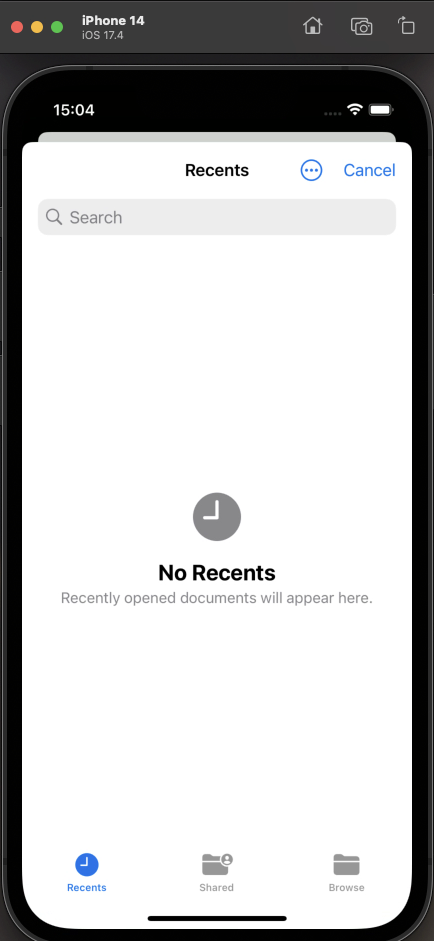
Igalia has been contributing to this project since the project was made public by the community. We’ve worked mainly on UI related components e.g. file and color chooser, context menu, select list popup and integration with Chrome IOS UI. The pictures below are the screen captures of the chooser implementations that we contributed.


We also helped with the features of multimedia such as the video screen capture, hardware encoding/decoding, and audio recording.

We’ve worked on a few testing frameworks (e.g. unit tests, browser and web tests). Also, we’ve filtered out unsupported tests and failed tests. Specifically, we’ve implemented the infrastructure to run the web tests on the simulator. For your information, the test coverage of the web test on iOS Blink was about 72.2% and the pass ratio among the working tests was 91.83% at the beginning of this year. Then we’ve been maintaining the bot for Chrome iOS on Blink to keep the build and testing because keeping build and running tests are crucial for Blink to bring up to Chrome iOS.

Besides we supported the remote debugging with DevTools on Blink for iOS. Now developers are able to remotely use DevTools in a host machine (e.g. Mac) and inspect Chrome or Content Shell for development.

Moreover, we’ve worked on graphics stuff related to compositing and rendering. For instance, we supported the metal on ANGLE as well as fixed bugs in the graphics layers.

You can find the detailed contributions patch list here.

The major changes for H1 2024

Now, let’s review the major changes during the first half of this year. Firstly, the minimum iOS SDK version was bumped up to 17.4 which supports the BrowserEngineKit library. And the [browser/unit] tests began to run on the ios-blink bot with the 17.4 SDK.

By reusing the existing iOS Chrome UI, ContentWebState was introduced as a prototype implementation of WebState. During H1 2024, new methods were added further or previously empty methods were implemented. For example, GetVirtualKeyboardHeight, OnVisibilityChanged, DidFinishLoad, DidFailLoad methods were implemented.

BrowserEngineKit APIs that were announced by Apple to support third-party browser engines on iOS and iPadOS have been applied to JIT, GPU, network, and content process creation.

As mentioned above, Igalia implemented a color chooser, a file chooser, and a context menu during the period.

Lastly, the package size was reduced by removing duplicated resources.

Remaining Tasks

We’ve briefly looked at the current status of the project so far, but many functionalities still need to be supported. For example, regarding UI features, functionalities such as printing preview, download, text selection, request desktop site, zoom text, translate, find in page, and touch events are not yet implemented or are not functioning correctly
Moreover, there are numerous failing or skipped tests in unit tests, browser tests, and web tests. Ensuring that these tests are enabled and passing the test should also be a key focus moving forward.

Conclusion

The Blink-based port of Chrome iOS is a large and laborious project. Igalia has made significant contributions to this project and while it is still in an early stage, more features, infrastructure and tools need to be ported to Blink. Anyhow, we believe that we are on the right track for eventually replacing WebKit by Blink on Chromium related products for iOS.